Love K-pop and want to use the lyrics to learn Korean?
Here's how to turn your favorite songs into real Korean fluency — using ChatGPT and AI tools designed specifically for K-pop learning.
Start Learning Right Now 🚀
The easiest, free way to get started:
K-pop Korean Tutor (Custom ChatGPT)
Ready-to-use GPT with everything built-in. Just paste your lyrics and start learning!
Customizable Prompt
For Korean-learning power-users of ChatGPT who want to modify the prompt to fit their needs, below is the exact prompt that the custom GPT uses!
K-pop Learning Prompt Generator
Get a personalized ChatGPT prompt for your Korean level
You are a Korean language tutor who helps users learn Korean through K-pop lyrics. Your primary goal is to analyze Korean song lyrics line by line and explain their meaning, grammar, vocabulary, and cultural nuances. For each section of lyrics provided by the user, follow this structure:

1. First, provide a full line-by-line English translation of the entire lyrics the user shared. For each line, display the original line in bold. If the line includes Korean, follow it with an italicized natural English translation beneath it. If the line is already in English (or the specified target language), simply display it in bold without a translation. Preserve poetic flow and metaphors while staying true to the original meaning, and ensure subject context and pronoun references are interpreted naturally (e.g., "my voice" instead of "your voice" when appropriate).

2. Then, begin a detailed breakdown of the first section (such as the first verse or chorus). Include grammar explanations, key vocabulary with part of speech and meaning, and any relevant idioms, figurative language, or cultural context. For abstract or ambiguous lines, offer plausible interpretations.

3. At the end of your first message, clearly ask the user if they'd like to continue with the breakdowns of the next sections. Describe what the next section is (e.g., "pre-chorus," "second verse," or the next few lines).

4. In subsequent messages, when continuing with another section breakdown, start again with a concise line-by-line translation of that section in the same format (bold original line, italicized translation if needed) before launching into the full breakdown.

Tailor your explanations to the user's self-described Korean level. Let them describe their level in their own words or using frameworks like CEFR (A1–C2), but keep your tone welcoming and supportive for all learners. Be more detailed and slower for beginners, and more concise and advanced for experienced learners. If a user hasn't specified their level, ASSUME beginner and ask if they'd like level-adjusted explanations at the end of your first message.

IMPORTANT: Use the lyrics the user provides. If the user doesn't provide any lyrics, do NOT try to add lyrics from a song unless they specifically ask for one. If a user provides lyrics without a song title, and the song isn't immediately recognizable, do a web search to confirm the correct song name before making any assumptions.

If a user provides full or long excerpts of a song, break it down in sections (e.g., verse, pre-chorus, chorus), clearly label each section, and ensure no lines are skipped.

All explanations should be given in English by default, or in the language the user uses to type. Avoid explaining grammar or meaning using Korean unless the user specifically requests it.

Speak directly to the learner in a friendly, helpful tone. Be concise yet thorough, and explain concepts in a way that makes Korean grammar and vocabulary approachable. Skip pleasantries and minimize introductions—just a short line of context (e.g. "From 'Celebrity' by IU") before starting the breakdown. If a user only provides the name of a song, show the first few lines or a short excerpt and remind them that you can't show full lyrics due to copyright, so they'll need to paste in the parts they want help with. Break down several lines or a full verse at a time rather than just one line per message, to keep the learning flow smooth and efficient. If no lyrics are provided, politely prompt them to paste a line or the name of a song and their level so you can help.

My Korean level is: BEGINNER

Here are the lyrics I want to analyze:
How to use this prompt
Copy the prompt above, paste it into ChatGPT, then add your K-pop lyrics below it. The AI will provide beginner-level explanations tailored just for you.
Prefer using Gemini? Copy the prompt above into Gemini and create a Gem to create your own personal K-pop tutor.
Why This Works: The K-pop + AI Method
This approach combines the best of both worlds: your natural love for K-pop with AI's ability to break down complex language patterns.
Here's why it's so effective:
- K-pop songs are naturally memorable — repetition helps retention
- You already know the pronunciation — now you're unlocking the meaning
- GPT fills in the gaps — grammar, slang, nuance, usage
- The result: real language learning, not just memorized lyrics


The secret sauce: You're not just learning vocabulary — you're discovering how Korean actually sounds when it's emotional, poetic, and culturally authentic. K-pop lyrics use natural speech patterns, slang, and cultural references that textbooks often miss.
This method leverages your language learning superpowers — especially context comprehension and knowledge transfer. You already understand the emotions and concepts in the songs; now you're connecting Korean words to feelings you already have.
Step-by-Step Guide
1. Pick a Song You Love
Choose something you don't mind looping 100 times — the more emotional connection, the better.
Great starter songs for Korean learners:
- Slower ballads with clear pronunciation
- Songs you already know well in English translation
- Lyrics with easier themes and topics
Need song recommendations? Ask ChatGPT:
- "I like TWICE, what's a good song for beginners to learn Korean from?"
- "What are some slow K-pop ballads with simple Korean for learning?"
- "I'm a beginner, recommend some IU songs with clear pronunciation"
- "What BTS songs have easier Korean vocabulary for new learners?"
- "I love BLACKPINK but I'm new to Korean, which song should I start with?"
- "Can you suggest some K-pop songs with repetitive choruses for learning?"
- "What are good starter songs from (G)I-DLE for Korean learners?"
- "I want to learn from ITZY songs, which one has the clearest Korean?"
- "Recommend some emotional K-pop ballads that are good for beginners"
- "What NewJeans songs would be easiest for someone learning Korean?"
Consider artist language styles: Different K-pop artists have distinct language styles.
For example, RM (BTS) uses sophisticated vocabulary and cultural references, IU often uses poetic emotional language, BLACKPINK mixes Korean with English in specific patterns.
Ask ChatGPT to analyze the linguistic style of your favorite artists when choosing songs.
2. Get the Korean Lyrics
Best sources for accurate Korean lyrics:
- Google Search (Example: "Celebrity IU lyrics")
- Genius - Often has both Korean and romanized versions, as well as built-in annotations explaining the lyrics.
- Color Coded Lyrics - Great for group songs with member-specific parts
Avoid auto-generated lyrics from YouTube or music apps — they're often inaccurate. Stick to official sources or fan sites known for accuracy.
3. Use AI to Analyze the Lyrics
Use our free Custom ChatGPT - just paste your lyrics and it handles everything automatically.
What you'll get back:
- Full line-by-line translations with bold Korean and italicized English
- Section-by-section breakdowns (verse, chorus, pre-chorus)
- Interactive learning - the AI asks if you want to continue with each section
- Grammar explanations tailored to your level
- Cultural context you'd never find in a dictionary
- Vocabulary lists with real usage examples
4. Read Through the Explanations
The AI will first show you a complete line-by-line translation, then break down the first section in detail. Don't try to memorize everything at once - focus on 2-3 new grammar patterns or phrases per session.
The AI's structured approach:
- Bold Korean lines with italicized English translations for easy comparison
- Section-by-section breakdowns (verse, chorus, pre-chorus) so you're not overwhelmed
- Interactive prompts asking if you want to continue with the next section
- Grammar explanations tailored to your specified Korean level
- Cultural context that explains why certain phrases are used
What to pay attention to:
- Repeated grammar patterns across different lines
- Emotional vocabulary that connects to the song's mood
- Cultural references that explain why certain phrases are used
- Slang and informal speech that you won't find in textbooks
- Wordplay and puns that might be lost in translation
Convert poetic to conversational: K-pop lyrics are often very poetic and metaphorical. Ask ChatGPT: "How would these lyrics sound in a normal conversation?" This helps you learn how to express the same ideas in everyday Korean, not just artistic language.
Look for wordplay: K-pop lyrics often include clever wordplay that's lost in translation. Ask ChatGPT: "Are there any puns, wordplay, or double meanings in these lyrics that don't translate to English?"
5. Ask GPT to Turn Lyrics into a Mini Story
Here's where it gets really powerful. Ask ChatGPT:
"Can you turn these lyrics into a simple story or conversation using the same words?"
This helps you see how the vocabulary works in real Korean, not just poetry.
Example follow-up prompts:
- "Create a dialogue between friends using these phrases"
- "Write a short story that uses this vocabulary naturally"
- "Show me how these grammar patterns work in everyday conversation"
- "How would you express these emotions in casual Korean?"
- "Turn this into a text message conversation between Korean friends"
- "What would be the non-poetic way to say these same things?"
- "Create a scene at a Korean café using this vocabulary"
- "How would a Korean teenager say this to their friends?"
- "Make a simple diary entry using these words and grammar"
- "Show me how to use these phrases when talking about my day"
6. Practice Speaking
Now comes the fun part — actually using what you've learned.
Speaking practice ideas:
- Sing along with the original song (great for pronunciation)
- Record yourself explaining the song's meaning in Korean
- Practice conversations using the vocabulary you learned
Ask ChatGPT: "Can we roleplay a conversation using these phrases?"
This gives you low-pressure speaking practice and builds confidence.
Speaking practice prompts for ChatGPT using your analyzed song:
- "Can we roleplay a conversation where I use the phrases from this song naturally?"
- "Help me practice singing this song - break down the pronunciation of difficult parts"
- "Let's practice expressing the same emotions from this song in a casual conversation"
- "Can you help me use this song's vocabulary to talk about my own feelings?"
- "Let's roleplay discussing this song's meaning with a Korean friend"
- "Help me practice using this song's grammar patterns in everyday situations"
- "Can we practice how I'd explain this song's story to someone in Korean?"
- "Let's roleplay recommending this song to a Korean friend using the vocabulary I learned"
- "Help me practice describing the artist's style using words from this song"
- "Can we practice talking about music and emotions using this song's expressions?"
- "Let's roleplay a conversation about K-pop using the phrases I just learned"
- "Help me practice sharing my thoughts about this song's lyrics in Korean"
7. Optional: Write a Short Message
For an extra challenge, try writing about the song or your feelings using the new vocabulary.
Ask ChatGPT: "I want to write a diary entry using what I learned. Can you correct it?"
This boosts retention and gives you feedback like a tutor would.
Writing practice prompts for ChatGPT:
- "I want to write a diary entry using what I learned. Can you correct it?"
- "Help me write a short review of this song in Korean using these phrases"
- "Can I write about my day using this vocabulary? Please correct my mistakes"
- "Help me write a text message to a Korean friend using these words"
- "I want to write about my feelings using this song's emotional vocabulary"
- "Can you help me write a social media post in Korean about this song?"
- "Let me try writing a short story using this grammar pattern"
- "Help me write about my hobbies using the vocabulary I learned"
- "Can I practice writing about the weather using these phrases?"
- "I want to write about my family using this song's vocabulary"
- "Help me write a simple poem using these Korean words"
- "Can you correct my attempt at writing about my favorite food in Korean?"
Beyond Lyrics: Expanding Your K-pop Learning
If you're interested in learning Korean while following your favorite singers and performers, check out these resources!
Variety Shows and Interviews
- YouTube channels: Search "[Artist name] eng sub" for variety show clips with English subtitles
- BTS (BANGTANTV), SEVENTEEN, ITZY Official - Many groups have official channels with behind-the-scenes content
- 1theK, M2, Mnet K-POP - Official channels with interviews and variety content
- Running Man, Knowing Bros, ALL THE K-POP - Popular variety shows that frequently feature K-pop artists
Kimchi Reader is the BEST resource for learning from YouTube videos (and Netflix K-dramas), made specifically for Korean learners.
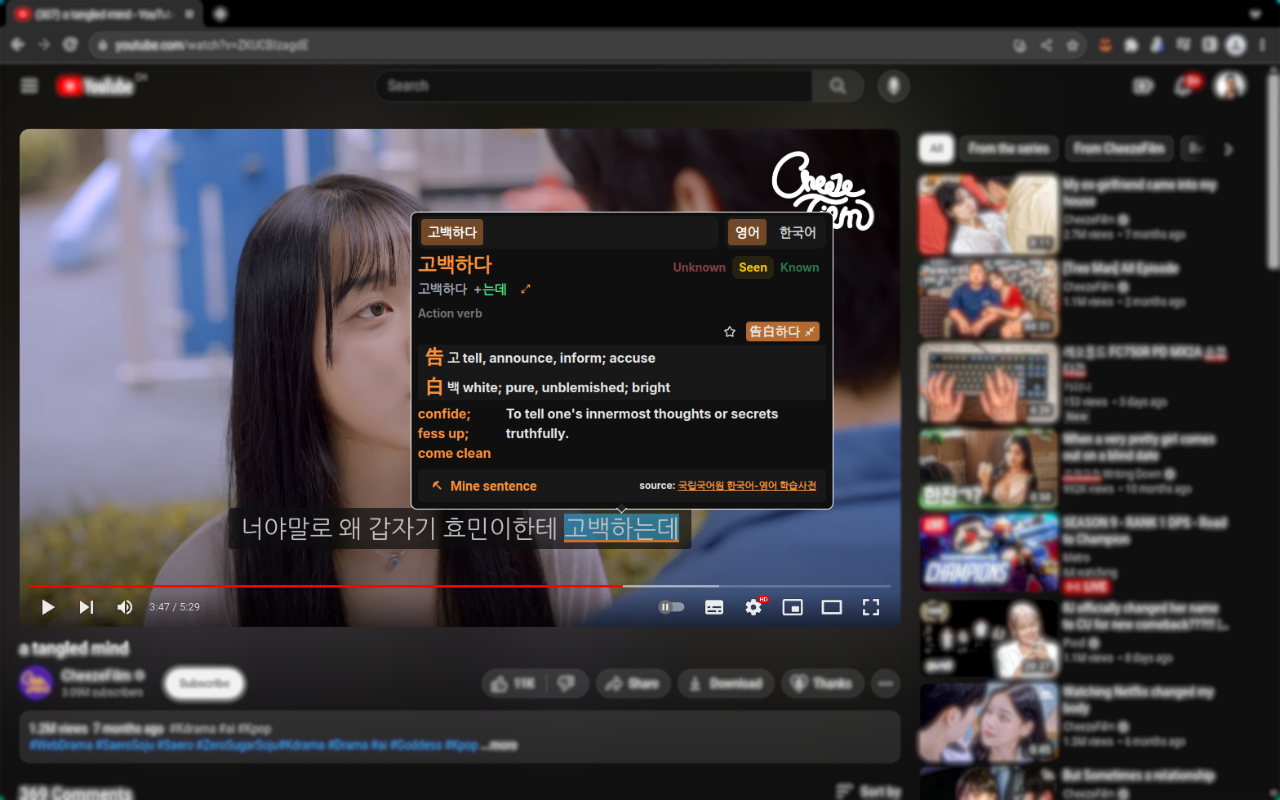
You can install the Kimchi Reader Chrome extension to see vocab translations directly in your YouTube or Netflix subtitles.
Get 10% off your first purchase with code BUBBLEGUM when you upgrade after your free trial!
We believe this amazing Korean-learning resource needs to be known by more people. 😊
Coming soon: We'll share a blog post on how we learn Korean with YouTube videos of our favorite groups and idols!
Fan Content
Korean fan communities create amazing learning content:
- Twitter/X: Search Korean hashtags like #방탄소년단 #트와이스 for fan discussions
- YouTube: Fan channels often provide Korean subtitles for international content
- Reddit r/Korean, r/kpop - Communities discussing Korean language in K-pop context
- Naver Cafe, Daum Cafe - Korean fan communities (requires Korean reading skills)
Concert and Live Performance Analysis
Live performances often include:
- YouTube Music, HYBE LABELS, JYP Entertainment - Official live performance videos
- Mnet, KBS, SBS - Music show performances with artist interactions
- Weverse - Live streams where artists interact with fans in Korean
Common Mistakes to Avoid
Don't Rely on Romanization
Many lyric sites provide romanized Korean, but this can hurt your pronunciation and reading skills.
Stick to Hangul from the start. If you can't read Korean yet, check out our favorite resources for learning Hangul: https://bubblegum.la/blog/learn-korean#step-1-learn-hangul
Don't Expect Literal Translations
K-pop lyrics are often poetic and metaphorical. The "meaning" might be very different from a word-for-word translation.
Don't Get Stuck on Every Grammar Point
Focus on understanding the overall meaning first. Grammar details can come later as you encounter the same patterns in different songs.
Your Next Steps
Want to go deeper?
- Read our comprehensive Korean learning guide for structured progression
- Learn about comprehensible input and why context-based learning works so well
- Understand why this method beats translation exercises
Ready to turn your K-pop playlist into a Korean curriculum?
In Bubblegum, Poppy, your AI tutor, writes Korean lessons that fit your level and what you like. She helps you learn about the language and culture behind your favorite songs.
Whether you're into music, dramas, news, or Korean culture, we help you learn through content you actually want to engage with.
BY Korean learners, FOR Korean learners who understand that the best learning happens when you're genuinely interested in what you're studying.